
The future of flight retailing starts at the checkout. The airline industry is undergoing a digital revolution, transforming payments from a routine finance task into a critical business driver. By building a robust, modern payment framework, airlines can seamlessly adapt to new OOSD retailing models, capture global markets, and turn one-time flyers into lifelong loyalists.
Airlines fly on razor-thin margins, with a global profit of USD 41 billion and net margin of 3.9% in 2026. In an industry where every dollar counts, relying on outdated, traditional payment systems is a massive risk.
Legacy infrastructure is quietly draining airline revenue in four critical ways:
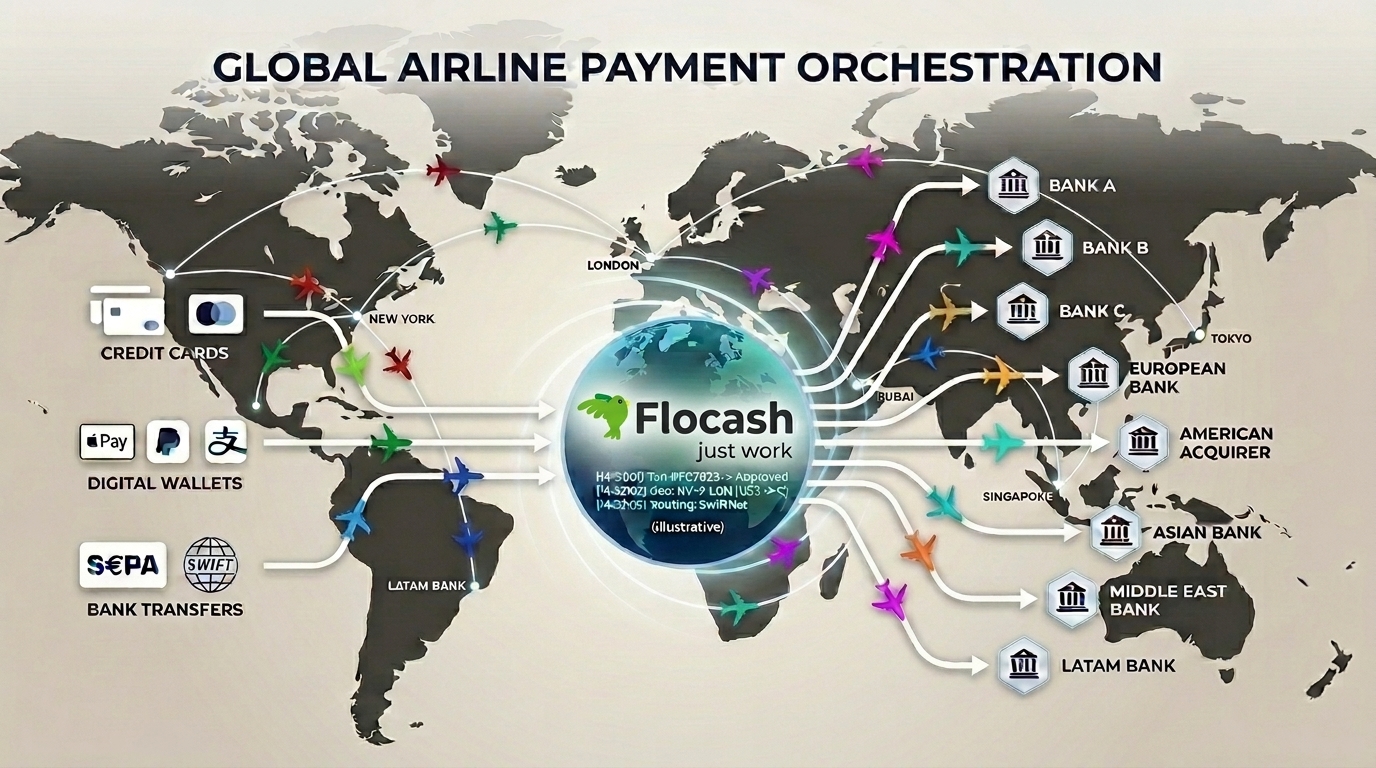
A Payment Orchestration Platform (POP) is a process of centralising payment processing through a single entry point for customer checkout via a website, mobile apps, or AI agents. It accepts all incoming requests and handles the routing, security, and management of transactions to the appropriate PSP, processor and acquirer . This eliminates the need for merchants to interact with multiple financial institutions directly.
By centralizing this infrastructure, airlines gain absolute command over how every transaction is directed, automatically re-attempted, and cleared using custom business rules. This intelligent steering enhances transaction success rates, builds instant backup networks to eliminate downtime, and dramatically simplifies the management of the entire financial stack.
Modern platforms offer a suite of specialized features tailored to high-volume travel commerce:
Implementing a POP provides measurable financial and operational gains:
Airlines need payment orchestration because payments are no longer just a cost of doing business—they are a revenue driver. In an industry where a 1% improvement in conversion can translate into millions of dollars in recovered revenue, having a flexible, data-driven, and resilient payment layer is a critical competitive advantage. As the industry moves toward native "Order" processing, the time to build a future-ready payment strategy is now
Airlines operate in one of the most complex payment environments, often facing thin profit margins—projected at just 3.6% in 2025. Key pain points identified in the sources include:
Operational Complexity: Managing dozens of different acquirers and payment methods globally creates a massive burden for finance teams, often requiring thousands of manual reconciliation hours annually.
Personalisation and market intelligence help you grow revenue faster. Below are selected insights to help sales teams improve performance and buyer engagement.
For airlines, payment orchestration is a strategic necessity that unifies fragmented global operations into a single intelligent layer.
LEARN MORE

Invisible embedded payments thrive on a hybrid strategy that balances seamless user experience with outsourced regulatory complexity.
LEARN MORE

Fintechs use BIN sponsors and technical enablers to access traditional card schemes, bypassing the high regulatory barriers of direct integration.
LEARN MORE